

When Chris Brown arrived on the music scene in the mid-2000s, he didn’t just bring vocal hooks—he revitalized the standard for high-octane commercial choreography. Across defining visuals like "Yo (Excuse Me Miss)" (2005), "Gimme That" (2006), and "Wall to Wall" (2007), a distinct movement language emerged that set him apart from his contemporaries. While each record adopted a completely different thematic world—from sunlit neighborhood sidewalks to a 1920s Harlem transit hub and a dark, gothic warehouse—the underlying mechanical foundation remained unmistakable: an explosive, low-center-of-gravity lateral glide that snaps into an abrupt, dead-stop freeze.
In commercial entertainment, a true signature move is not just a rehearsed step; it is an unforgeable physical watermark that communicates an artist’s identity in a fraction of a second. When Michael Jackson executed the moonwalk or hit his gravity-defying toe stand, it was an illusion of levitation—ethereal, theatrical, and steeped in classical illusionism. Conversely, Usher’s signature language centers on silky, glide-heavy pocket work; he leans into the lineage of Gene Kelly and Sam Cooke, making complex isolations look completely effortless, sensual, and suave. Chris Brown’s signature, by contrast, rejects both ethereal levitation and effortless cool in favor of explosive athletic kineticism. His movement does not ask the audience to marvel at how light he is on his feet; it demands that they feel the brute force of his acceleration and the sheer physical torque required to snap that velocity into a complete dead stop.
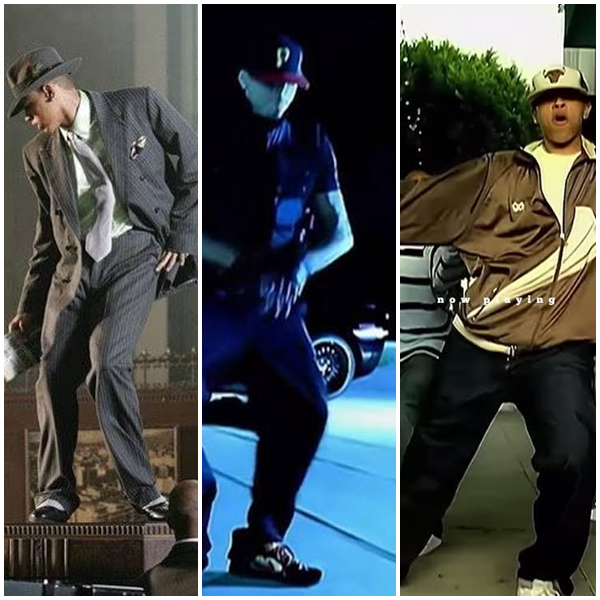
The brilliance of this signature dynamic lies in its contrast. Brown frequently borrows from the street vernacular of popping, b-boy glides, and classic James Brown shuffle footwork, sinking deep into his knees with a forward chest tilt to slide laterally across the floor with near-frictionless ease. Yet, rather than letting the glide flow continuously, he consistently fractures the motion with sudden physical locks on the snare hits. In "Yo," this manifests as a loose, flirtatious drift interrupted by rhythmic pauses; in "Gimme That," working alongside choreographers Rich & Tone, it accelerates into rapid-fire heel-toe syncopations; and by "Wall to Wall," it mutates into aggressive, sharp-angled formations that project sheer kinetic force.
Tying these technical footwork sequences together is his natural flair for street pantomime and acrobatic recoveries. Across all three videos, Brown anchors his high-speed routines with small, charismatic micro-gestures—whether it is tilting a fitted cap on a street corner, adjusting the lapel of a zoot-suit fedora, or using sharp chin drops to frame his face right before dropping into the pocket of the beat. When combined with floor-skimming spins, knee slides, and effortless pop-up recoveries, these elements created a cohesive performance identity that defined the golden era of 2000s R&B dance.
What truly separates Brown from his peers—and cements his place alongside the titans of performance history—is his ability to bridge underground street battle culture with stadium-grade commercial precision. While an artist like Justin Timberlake leaned into smooth, syncopated funk steps and Omarion channeled disciplined, tight hip-hop choreography, Brown integrated the raw fury of early-2000s Los Angeles Krump, the acrobatic risk of B-boy power moves, and the calculated isolations of classic West Coast Popping into a mainstream R&B framework. When he drops into his low-stance glide in "Gimme That" or "Wall to Wall," he is not simply executing an eight-count for a camera angle; he is battling the rhythm itself. Where other industry icons use choreography as an elegant backdrop to support their vocal performance, Chris Brown approaches dance as a high-contact athletic discipline, weaponizing speed, level changes, and aggressive mechanical locks to establish a physical dominance that few entertainers in pop music history can match.